In short. The criticality of a piece of knowledge is the product of its vulnerability and its relevance. Vulnerability combines availability, transmissibility and confidentiality; relevance combines usage, adequacy and historical importance. Availability is never typed in: it is recomputed from the real number of people assessed at a sufficient level.
This is the engine of the product, and it is deliberately simple enough to be argued about in a meeting.
Criticality = Vulnerability (V) × Relevance (P)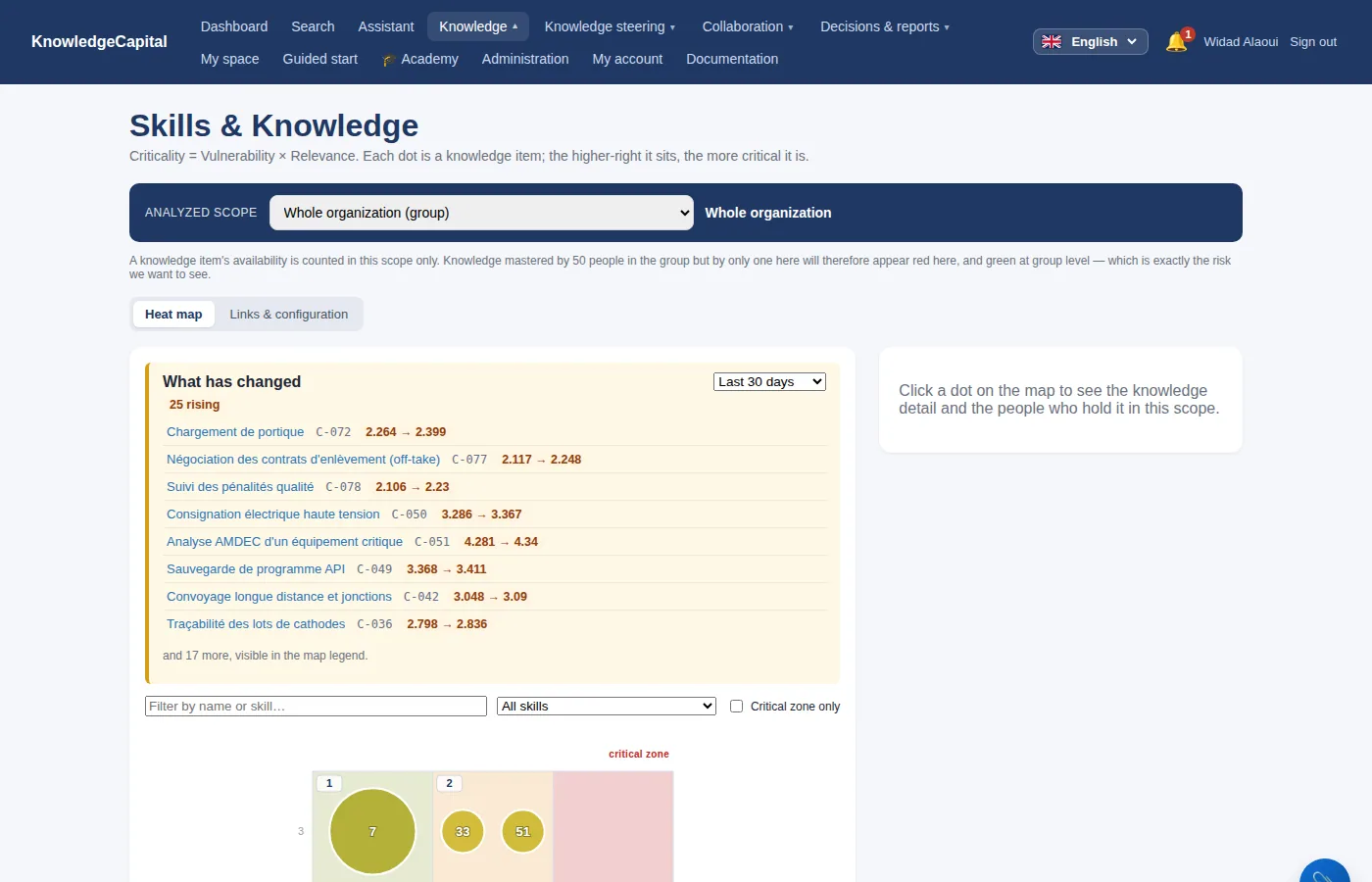
Vulnerability — how exposed the knowledge is
| Criterion | Who sets it | Meaning |
|---|---|---|
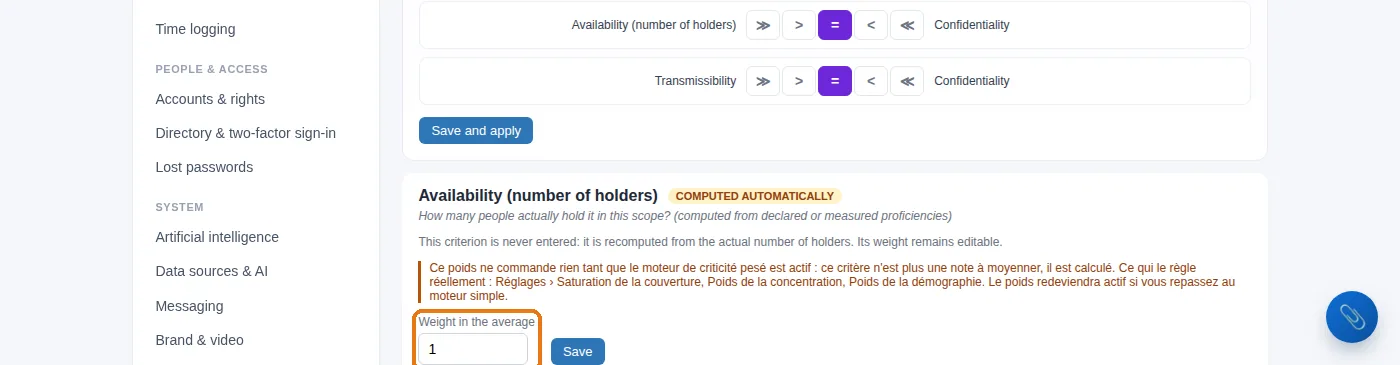
| Availability | Nobody — computed | Derived from the real number of people whose mastery has been assessed at a sufficient level. It changes on its own when someone leaves, is hired, or is trained. |
| Transmissibility | Knowledge manager | How hard this is to pass on. A checklist transmits in a day; a judgement built over ten years does not. |
| Confidentiality | Knowledge manager | How restricted the knowledge must remain, which limits how widely it can be spread as a mitigation. |
Relevance — how much it matters
| Criterion | Meaning |
|---|---|
| Usage | How often the knowledge is actually needed. |
| Adequacy | How well it fits what the organisation does today. |
| Historical importance | What it has cost the organisation to acquire. |
Ranks and weights
Each criterion is scored on a rank from 1 to 3, and each carries a weight you can configure. The defaults are sensible; changing them is a governance decision, made once, in the Settings screen — not something to adjust per item.
Mastery: the yellow stars
A person's command of a piece of knowledge is a level from 0 to 5, where 5 means "can teach it". Availability reads these levels. This is why the assessment step cannot be skipped: it is the only input the machine cannot invent.
Why availability is never typed in. Because a number that can be typed in can be reassured. When the only way to lower a risk is to actually train someone, the map stops being a negotiation and starts being a measurement.
See also: Mapping critical knowledge: the method · Your first hour: a first real diagnosis · The modules of the knowledge ERP · Losing know-how: the problem it solves · Key-person risk: knowledge held by one person · Succession planning for critical knowledge
Frequently asked questions
Can the criteria weights be changed?
Yes. Each criterion carries a configurable weight, set once in the Settings screen. It is a governance decision, not an adjustment made item by item.
Why can availability not be edited?
Because a typed-in figure can give false comfort. Availability is recomputed from assessed mastery levels: the only way to lower the risk is to actually train someone.
What do mastery levels 0 to 5 mean?
They are a person's level on a piece of knowledge: 0, no mastery; 5, able to teach it. Availability is computed from these levels.