KnowledgeCapital

KnowledgeCapital › Docs

Step 1 — The org chart, starting from a single structure

How to create an org chart: rename the root structure, create the departments under it, name the levels, and avoid the two-roots trap.

In short. A blank space starts out with a single structure, the root, and everything sits under it. In Administration then Org chart, you rename it with the name of your organisation, then create your departments with “Create a sub-structure”. The “Org chart” line turns green as soon as there is a structure under the root.

A blank space starts out with a single structure, the root, which bears the name given when the space was created. Everything else will sit under it.

1. Select the root
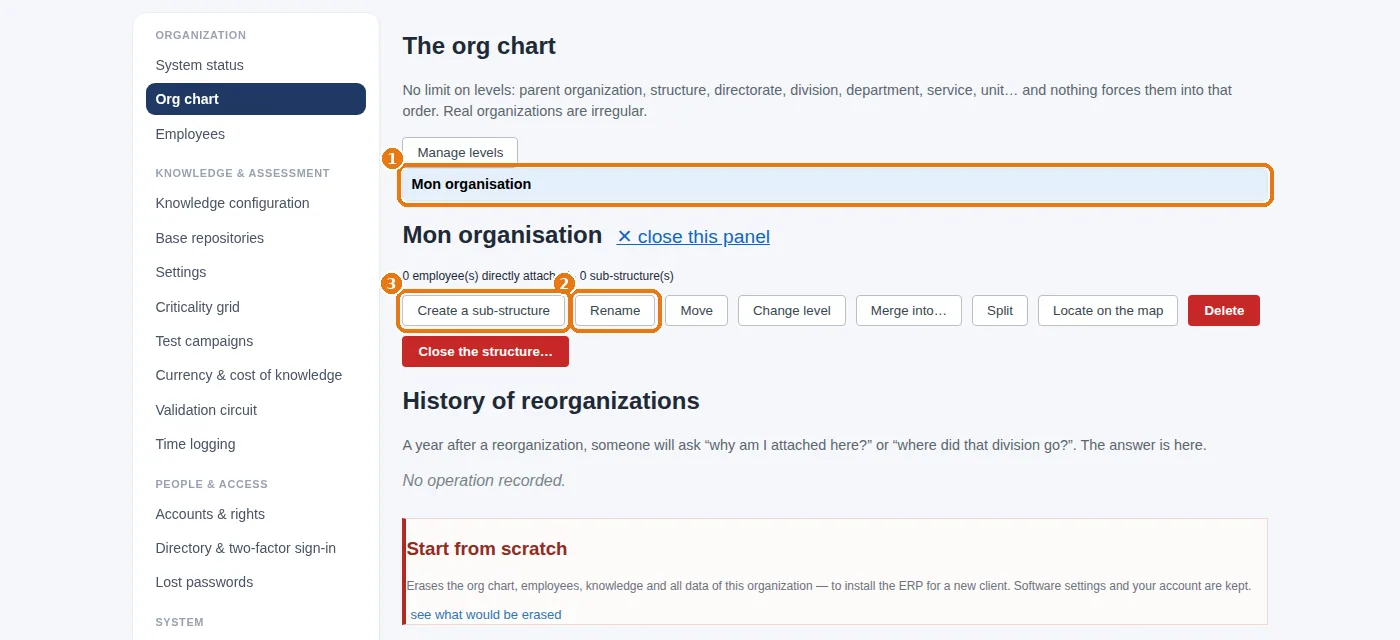
1
Administration › Org chart. Click 1 the name of the structure: its record opens below, with its actions — including 2 Rename and 3 Create a sub-structure.
The blank org chart: a single structure, selected, with “Rename” and “Create a sub-structure”.

2. Correct its name if needed

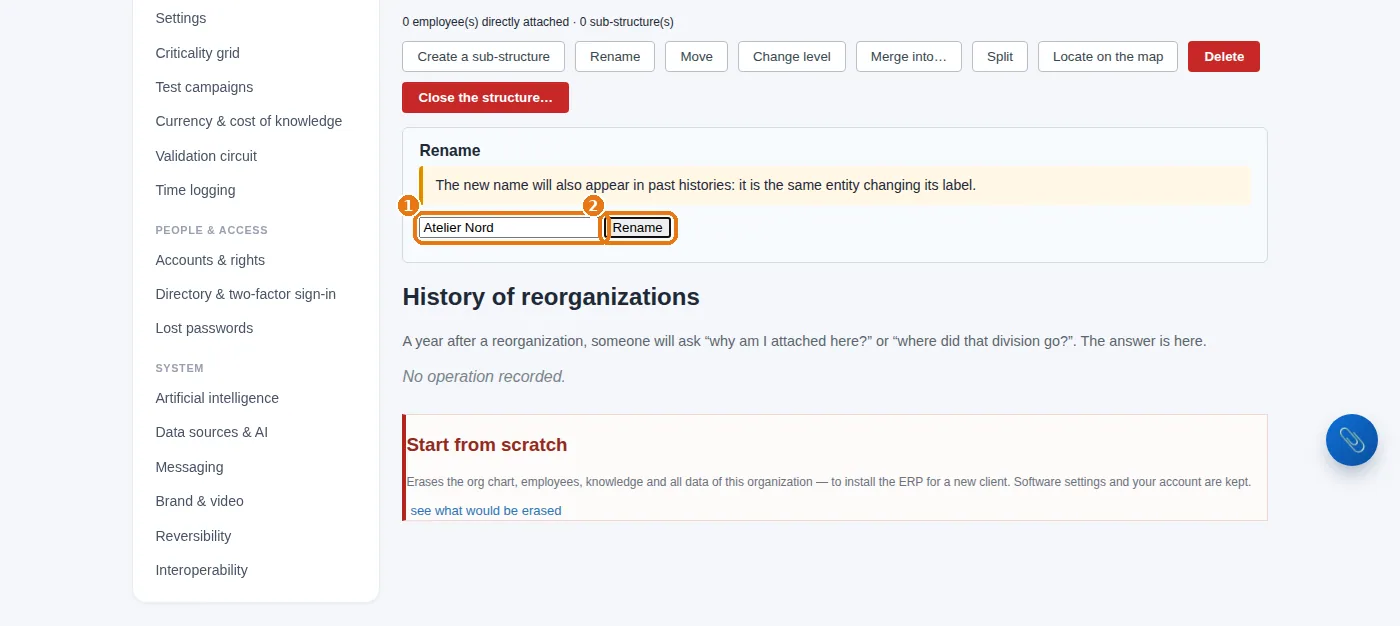
1
Click Rename. A panel opens: 1 type the exact name of your organization (here, “Atelier Nord”), then click 2 the panel's Rename button.
The “Rename” panel: the new name, then the panel's button.

The new name applies everywhere, including in the history: it is the same entity under a new name.

3. Create the departments under it
1
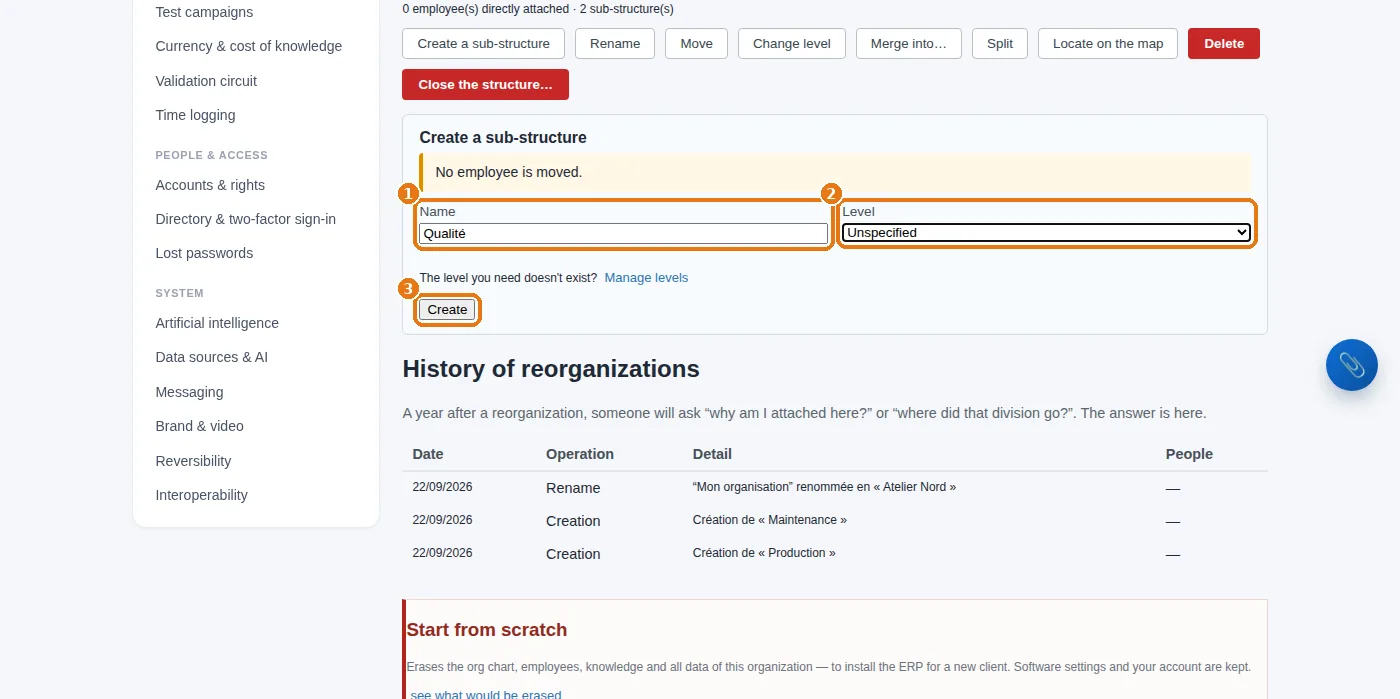
With the root still selected, click Create a sub-structure.
2
1 the name of the department (“Maintenance”); 2 its level, optional (leave Unspecified if you are unsure); 3 Create.
3
Select the root again and repeat for “Production”. For a department under another department, select the parent department first.
“Create a sub-structure” under the root: the name, the level, then “Create”.
The first-day trap: two roots. Always create under a selected structure. A second root gives you two organizations side by side, and calculations by scope no longer make sense. One root, many branches.
Two buttons not to mix up. Next to the name of the structure, clicking close this panel simply closes the record. The red Close the structure… button closes the structure itself (it ceases to exist for calculations, and its people must be moved elsewhere). It asks for confirmation, but only use it for a genuine reorganization.

4. Name the levels (optional)

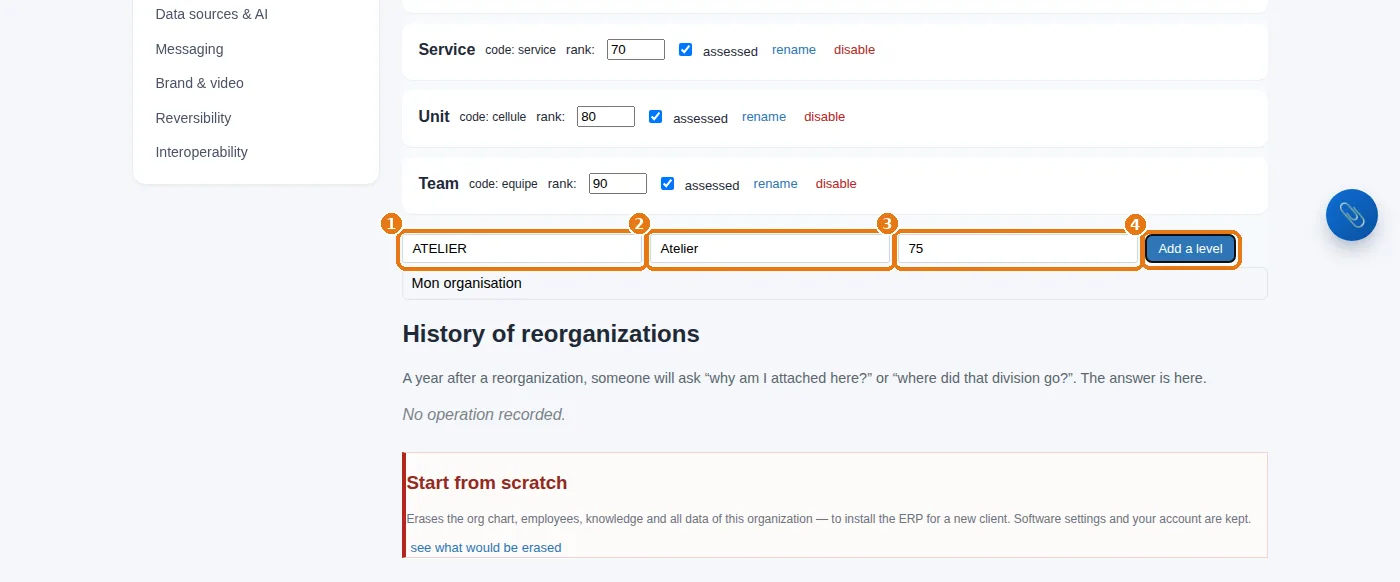
Levels (division, unit, department, workshop…) are never a blocker; they make reports easier to read. Manage levels:
1
1 a short code (“ATELIER”), 2 the label (“Atelier”, i.e. workshop), 3 the rank: the lower the number, the higher the level (here 75, to place the workshop between the department, rank 70, and the cell, rank 80), then 4 Add a level.
“Manage levels”: a code, a label, a rank, then “Add a level”.

5. What you should see

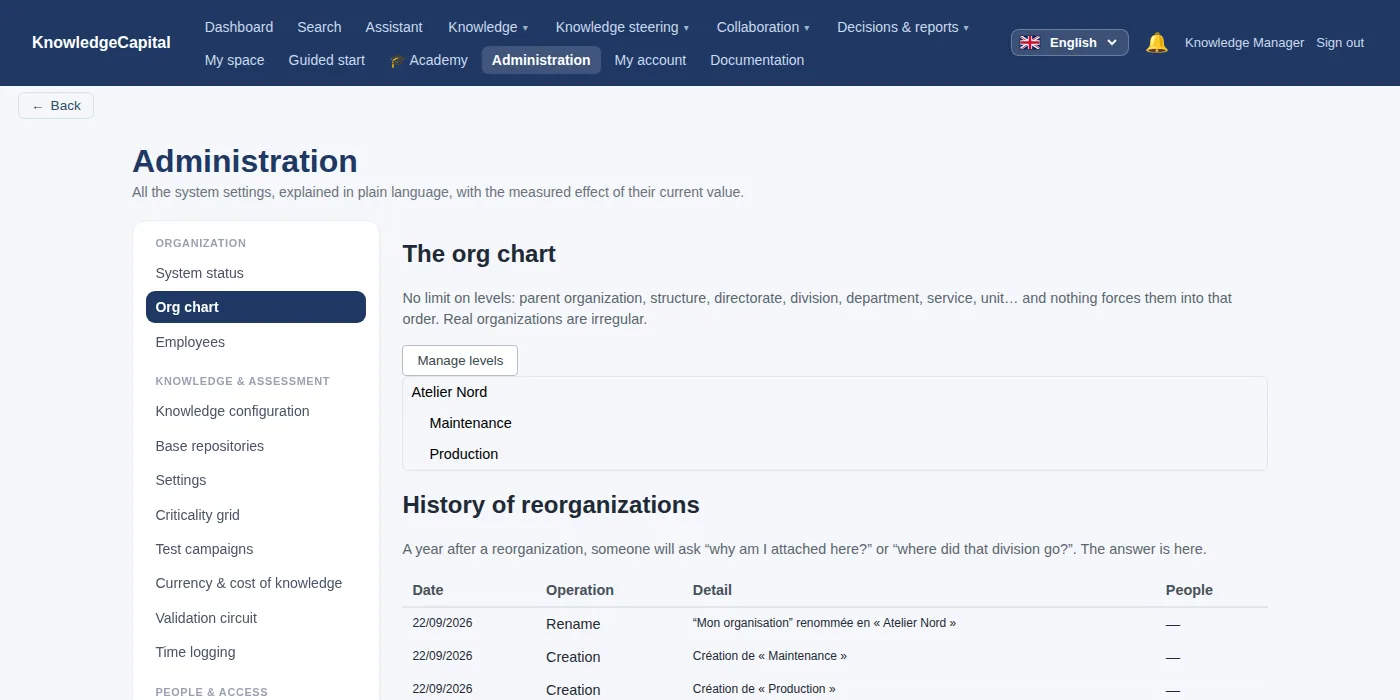
The guide's org chart: Atelier Nord, with Maintenance and Production below it.

Three structures are enough for this whole guide. In “System status”, the “Org chart” line turns green as soon as there is a structure under the root.

Is your org chart already in a file? The employee import (next step) detects structures that do not exist yet and offers to create them, under the structure of your choice — never at the root by default. So you can create just the main branches here.

Later: reorganizing without losing anything

On a structure's record: Move (put it under another structure), Change level, Merge into… (two departments that become one), Split (the reverse), Locate on the map (place this site on the map, for organizations with several locations). Each operation is dated in History of reorganizations: a year later, you still know why someone is attached here.

Your org chart in a few clicks.One root, many branches: each department you create then takes in its people, its processes and its knowledge. You can try it on your own names for 14 days, with no card. Start a free 14-day trial (no card needed) or request a demo.

See also: Step 2 — Positions, then people: by hand or from a file · Step 4 — Processes and tasks: what makes a knowledge item relevant · End of setup: the check, line by line · How to build a knowledge management system from scratch · A knowledge ERP: what your ERP does not manage

Frequently asked questions

How do you create an org chart in KnowledgeCapital?

Administration then Org chart: select the root structure, rename it with the name of your organisation, then create each department with “Create a sub-structure”.

Can an org chart have two roots?

It should not: a second root gives you two organisations side by side, and calculations by scope no longer make sense. Always create under a selected structure.

How do you reorganise a department without losing the history?

On a structure's record: Move, Change level, Merge into…, Split. Each operation is dated in “History of reorganizations”.

Docs