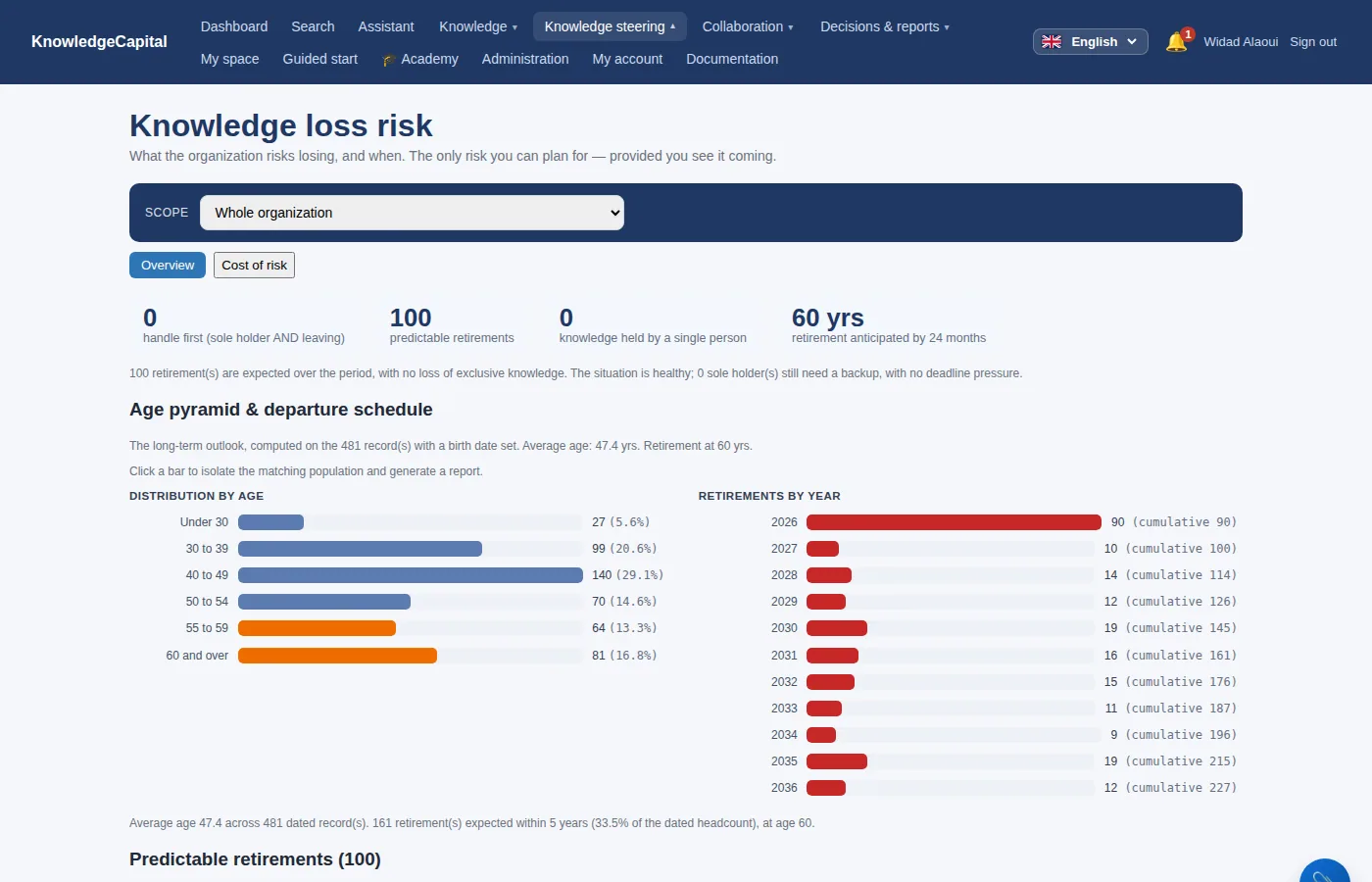
In short. Know-how is lost in three ways: retirements, turnover, and knowledge held by a single person without anyone having decided so. None of them shows on a dashboard. KnowledgeCapital counts the actually assessed holders of every piece of knowledge: when their number falls, criticality rises by itself.
An industrial plant loses knowledge in three ways, and none of them appears on a dashboard:
Retirement
The maintenance supervisor who has felt that pump wrong for eleven years retires in March. Nobody has ever written down what he hears. The handover is two weeks, most of it spent on paperwork.
Turnover
A process engineer resigns. Her replacement is competent, and takes nine months to reach the same output — because the knowledge that mattered was not in the procedure, it was in the exceptions she had learned to expect.
Silent single points of failure
Nobody decided that only one person would know how to restart the flotation line after an emergency stop. It happened. And because it happened gradually, nobody noticed.
Why the usual answers do not work
- "We have procedures." Procedures describe the normal case. Value lives in the abnormal one.
- "We have a wiki." A wiki holds what somebody chose to write. It is silent about what nobody wrote — which is exactly the risk.
- "HR tracks skills." A skills matrix says who has a certificate. It does not say who is the only person who can do the thing.
KnowledgeCapital measures the third case directly. When a piece of knowledge is held by one person instead of four, its criticality rises by itself — nobody has to notice, and nobody has to declare it.
The measure that changes the conversation. Availability is never typed in by hand. It is recomputed from the real number of people whose mastery has actually been assessed. A manager cannot reassure themselves by declaring a risk closed.
See also: Knowledge criticality: how it is computed · Your first hour: a first real diagnosis · Retirement: how to stop losing know-how · Mapping critical knowledge: the method · Key-person risk: knowledge held by one person · Knowledge transfer before retirement: the method
Frequently asked questions
How do you spot knowledge held by a single person?
By assessing, for every piece of knowledge, each person's mastery level. Availability is recomputed from the number of assessed holders: knowledge with only one holder rises to the top of the at-risk list.
Isn't an HR skills matrix enough?
It says who holds a diploma or a certification. It does not say who is the only person able to perform a task, nor what their absence would cost. That is the missing measurement.
How long before a departure should you start?
Three to six months for ordinary know-how; twelve to twenty-four months for critical know-how carried by one person for a long time. Hence the value of measuring early.