In short. Targeting starts from the map, not from a calendar: a campaign proposes to summon the people whose knowledge items have turned orange or red, and each line says why. Allow at least six validated questions per critical knowledge item, across three difficulty levels. Adaptive mode tests each person on the knowledge of their own tasks.
Whom the system suggests testing, and why
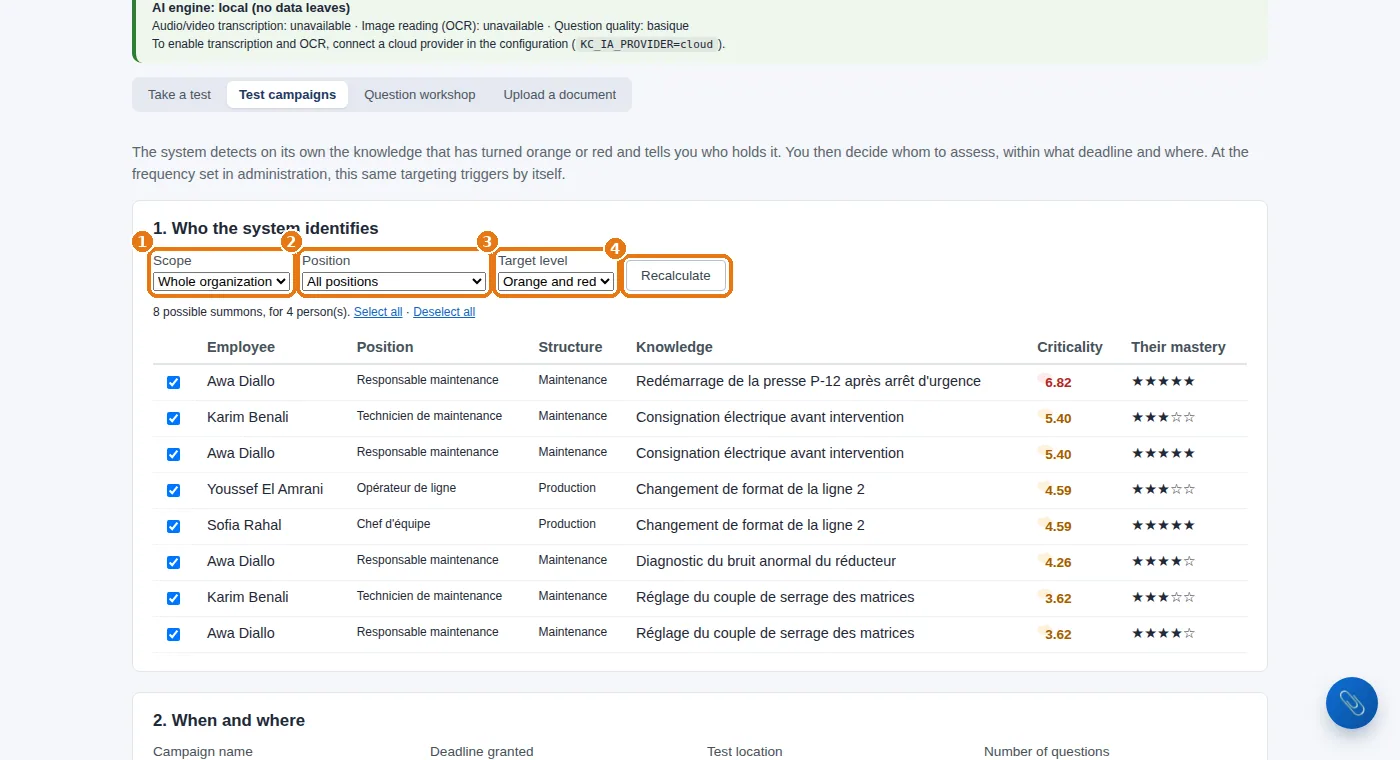
Targeting starts from the map, not from a calendar. A campaign proposes to summon the people who hold (or should hold) knowledge items that have turned orange or red within the chosen scope. Each line of the list gives the knowledge item, its criticality and the person's current mastery level: you know why each person is being summoned, and you can untick anyone you like.
| Setting | Where | Effect |
|---|---|---|
| Target level | The campaign, section 1 | Orange and red (the most common), red only (urgency), orange only (prevention) |
| Position and experience | Test campaigns | Each person's expected level: questions too easy for their profile are left out |
| Exemption | Test campaigns, the person's record | A person who is never to be summoned (with a reason). What they know is still listed in “Who is not assessed” |
| Automatic rhythm | Settings › Test campaigns | The number of days between two campaigns, and the switch for automatic triggering |
A question bank you can trust
Adaptive mode
In adaptive mode, each person is tested on the knowledge of their own tasks, at a difficulty calibrated to their profile (position, status, experience). This is the mode to prefer as soon as tasks have been assigned: it avoids testing an operator on things they never do. See what would be asked shows, for a given person, the exact questions they would face, and why.
Reading the results
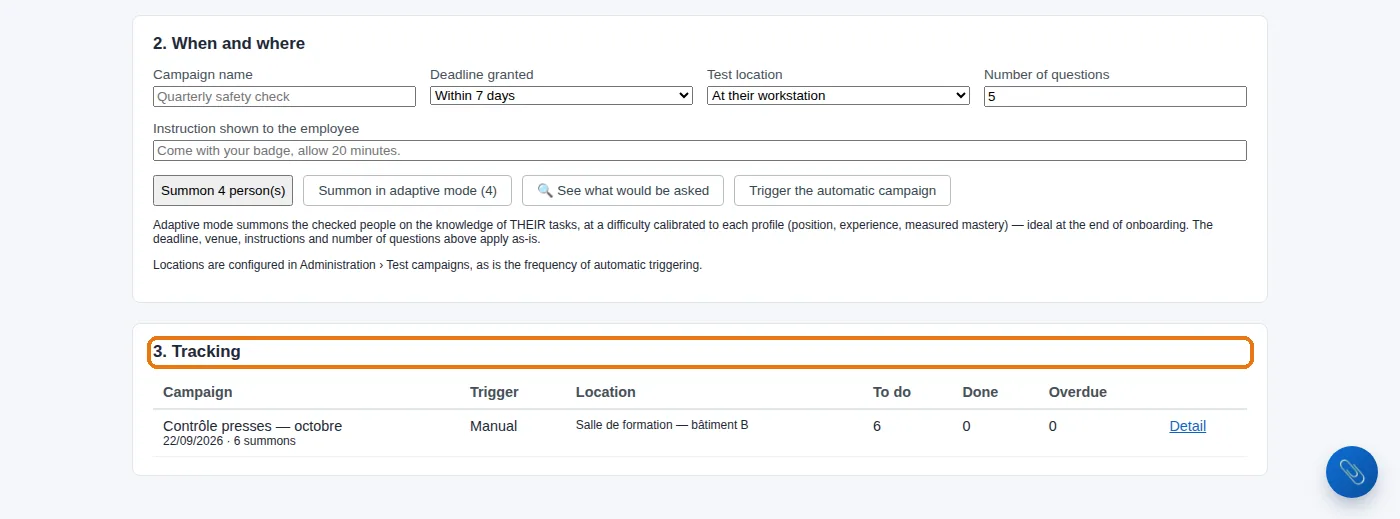
- A result updates the person's measured mastery level; the map, the risk and the reports are recalculated automatically.
- A gap between declared and measured level is not a fault: it is information. A systematic gap within a team tells you that declarations there are optimistic.
- Failures concentrated on one question tell you the question is bad; concentrated on one knowledge item, they tell you there is a real gap (see case 8).
What about the Academy?
The Academy offers training paths whose results are proven by tests. It is unlocked with an activation code supplied by your provider; once activated, all the employees in the space can access it. It is kept when the space is reset.
See also: Step 9 — Tests: locations, questions, a first campaign · Step 5 — Who knows what: mastery, and a map that finally tells you something · When something is identified: the situations, and what to do step by step · Skills mapping: method and software · Knowledge management system: a 12-point evaluation grid
Frequently asked questions
How does the system choose who to test?
From the map: it proposes to summon the people who hold, or should hold, knowledge items that have turned orange or red within the chosen scope. You can untick anyone you like.
What is adaptive mode?
Each person is tested on the knowledge of their own tasks, at a difficulty calibrated to their position, status and experience. It is the mode to prefer as soon as tasks have been assigned.
How many questions do you need per knowledge item?
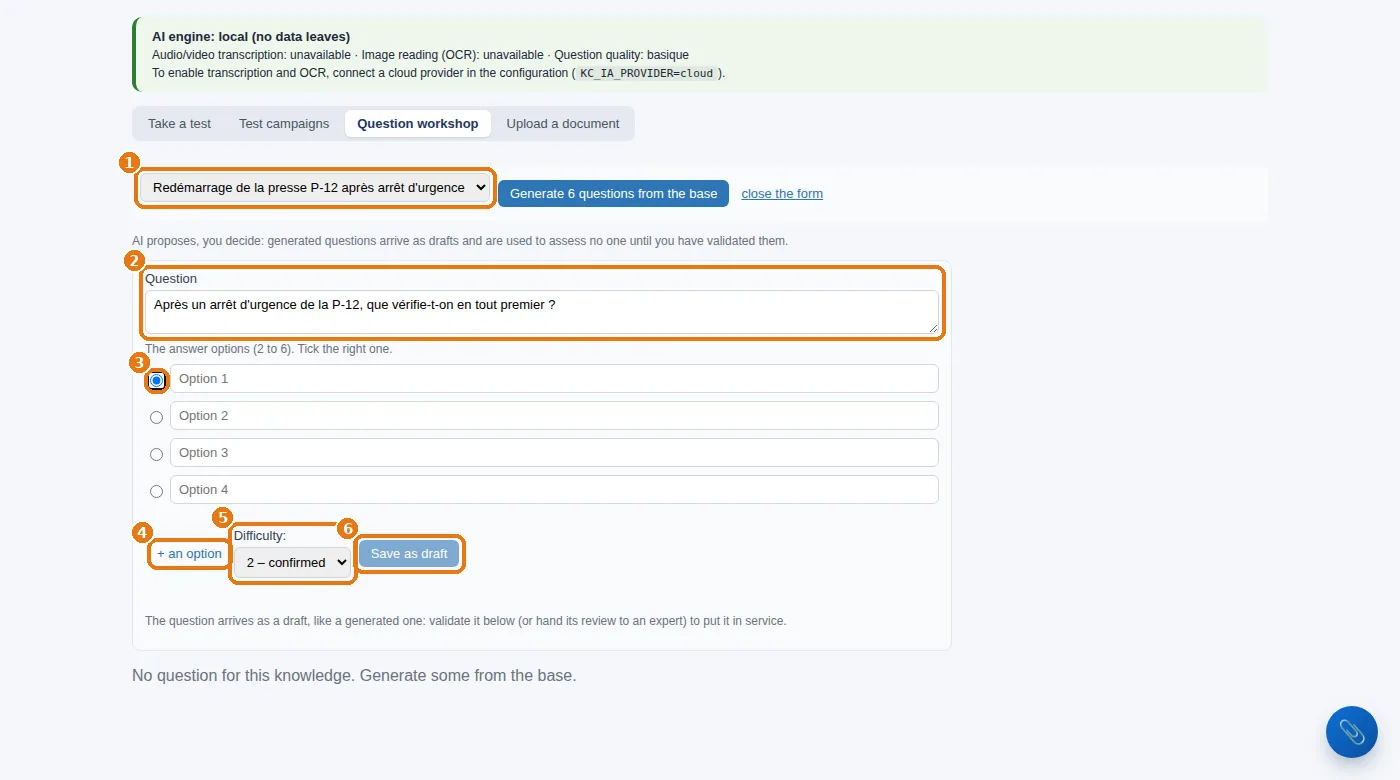
At least six validated questions per critical knowledge item, spread across three difficulty levels: beginner, confirmed and expert.